
Najeonchilgi: The Korean Art of Mother-of-Pearl Lacquer
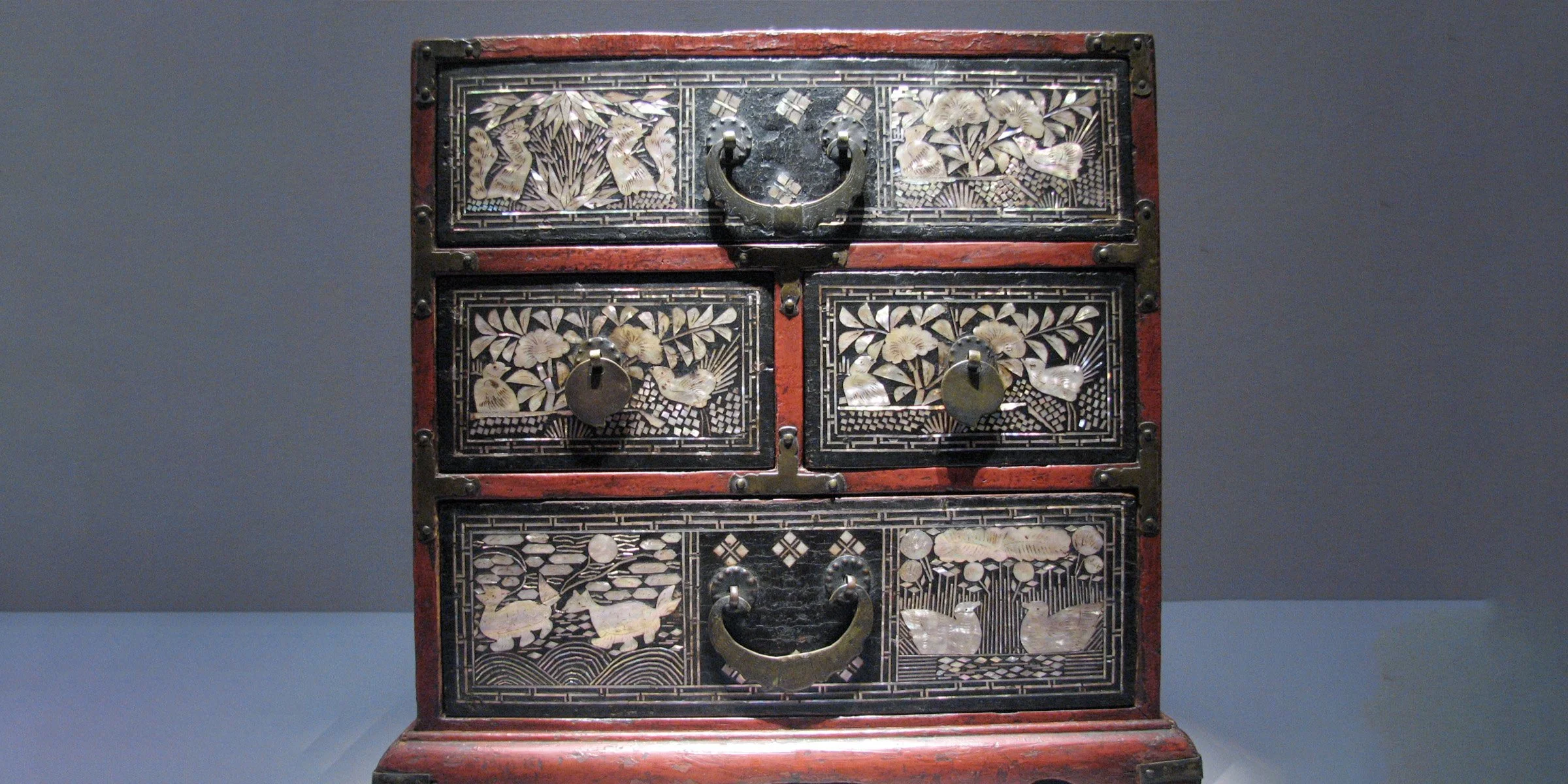
Photo by Sarah Kim, “Antique Furniture.”
Najeonchilgi, the art of embedding shells into lacquerware, is a particular form of Korean craft that imbibes beauty into everyday objects like chests, boxes, and jewelry. Dating back thousands of years to the Three Kingdoms period, najeonchilgi refers to both the specific tree sap-based lacquer used to protect the materials and the shell, typically abalone, inlaid into the goods alongside twisted metal wires, depicting various symbols or designs. The calcium carbonate content of the shell interacts with the light, creating a shimmering surface to the inlay that is both beautiful and resilient when combined with the resin lacquer.
The legacy of najeonchilgi, spanning back to the early days of the Three Kingdoms period, flourished during the Goryeo period, where it became a symbol of aristocracy. Chinese Tang Dynasty artisans and Japanese craftspeople also integrated embedding shells in lacquer in their own distinctive crafts, but the technique took on its own life in Goryeo-era Korea. As the state recognized the munban (civil officials) during the Goryeo period, elaborate workshops of artisans were established to meet the demands of an ever-expanding court. The Goryeo period also integrated Confucianist and Buddhist symbolism into the najeonchilgi depictions, although today only twenty pieces of Goryeo najeonchilgi remain. By the late Joseon period, najeonchilgi had become much more pragmatic and commercialized, integrated into furniture and household goods like hairbrushes. It was also given as a representative gift of Korea to visiting emissaries and diplomats during Joseon-era historic negotiations.
Today, modern-day najeonchilgi artisans first begin by collecting lacquer by scoring the lacquer trees and collecting the sap, which is then refined into varnish through various steps including adding additional materials like iron powder to give it a deep black color, often distinctive to Korean lacquerware. The lacquer, the tree resin mixed with materials and sticky rice paste, is then applied to the base material of the najeonchilgi, often wood, but sometimes leather or ceramics, before being covered with a base cloth. As for the shell, the abalone is ground down until uniform in thickness, usually about 0.2-0.3mm in width, applied to a base, and arranged into patterns and designs. Often the base is a design template, which allows the artist to arrange the pieces before transferring them to the object. It is then paired with gold or other metallic filament, as well as sometimes red or gold tortoise shells, to enhance the detailing of the designs. A lacquer top-coat is then applied, and lastly, scraped off to expose the mother-of-pearl design.
After the Japanese occupation of Korea, najeonchilgi resurfaced as a distinctly Korean artform and a sign of wealth, and was officially named a National Intangible Cultural Heritage of South Korea in 1966. As demand for the pieces increased, the Korean shell supply dwindled, causing prices to soar and shells to be imported. The increasing prices slowed demand for the pieces, and it fell out of popularity in the ‘80s and ‘90s as South Korea underwent challenging economic times. Today, najeonchilgi artisans, while limited, continue the cultural heritage practice, with their pieces featured in Korean homes, museums and art displays across the world, and in dedicated heritage sites like the Korean Museum of Craft Art.