
Ringing in the New Year at Bosingak Belfry
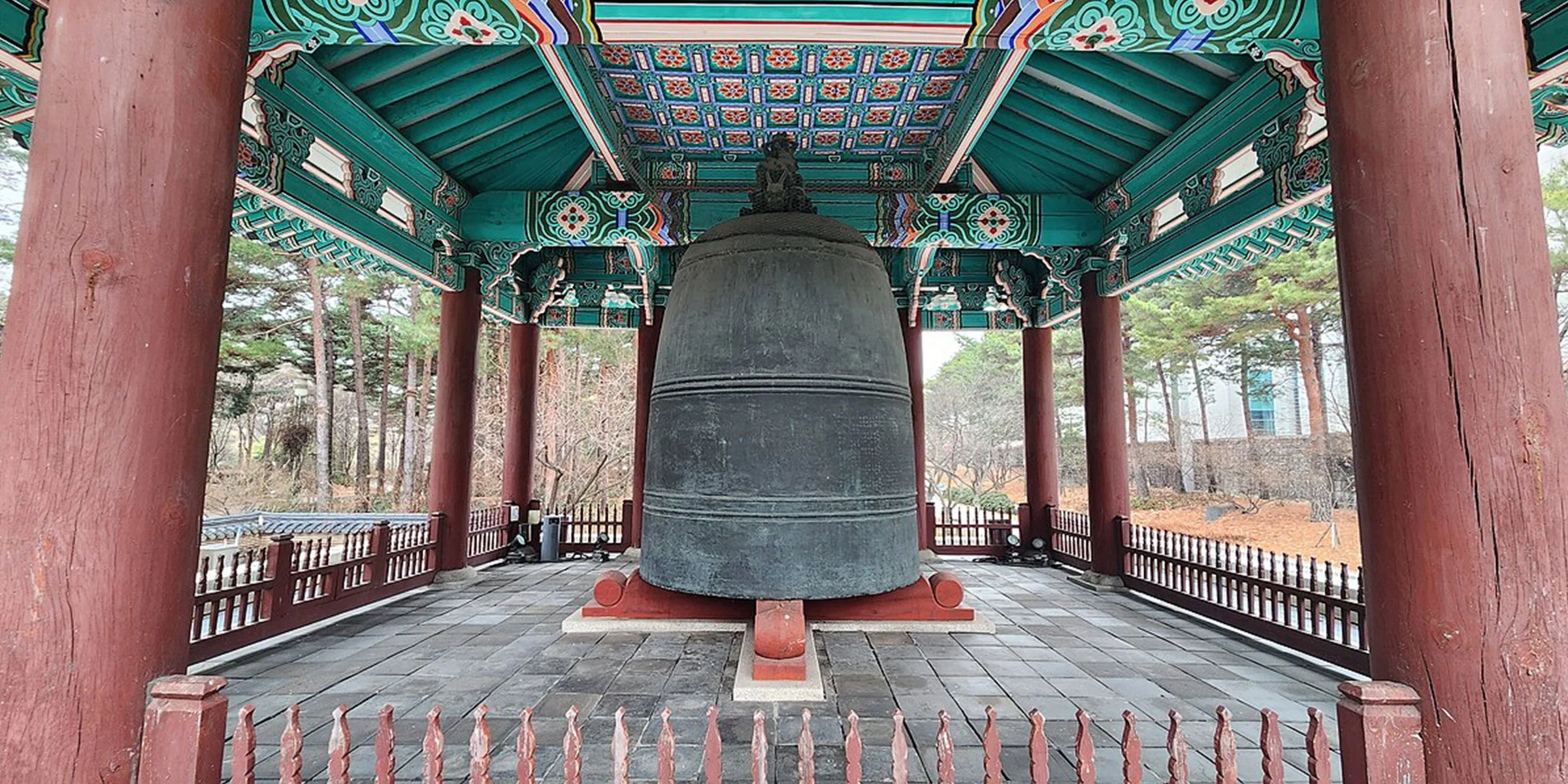
LR0725, CC BY-SA 4.0 <https://creativecommons.org/licenses/by-sa/4.0>, via Wikimedia Commons
Every New Year's Eve over 100,000 people gather along the frigid Seoul streets at Bosingak Pavilion to hear the 33 chimes of the Bosingak Bell at midnight on January 1st, welcoming the new year. Bosingak, the historic bell pavilion, dates back to the 14th-century Joseon.
The Bosingak Bell initially played a critical role in the city’s defense system, ringing at the opening and closing of the four Seoul City Gates at curfew times (4:00 a.m. and 10:00 p.m.) and during emergencies. Nowadays, the Bosingak Bell is ceremonial, welcoming in the new year for the residents of Seoul and the country of South Korea. The Eight Gates of Seoul and City Wall system built during the early Joseon period surrounded the downtown area of the capital, then called Hanseong.
While the original bell and pavilion no longer play a role in New Year’s festivities, being destroyed by numerous fires over the last 600 years, the oldest iteration of the bell, dating back to a 15th-century reconstruction effort, was removed in 1985 for preservation purposes, and is now displayed in the National Museum of Korea. Weighing 19.66 tons, the original bell is constructed entirely of bronze, featuring faintly engraved bodhisattva images alongside the names of those involved in its construction. The Bosingak belfry pavilion, reconstructed in 1979, is a two-story structure painted in red and blue/green, the traditional symbolic colors of the Korean Dancheong Tradition: red for protection and green/blue for growth and harmony. The bell in the square today is a replica, created in the 1980s to replace the deteriorating 15th-century bell.
To ring the bell, selected participants take turns swinging a hanging log like a pendulum to strike the exterior of the bell. The 33 chimes refer to the 33 heavens of Buddhism, and is the same number of chimes the original bells would play to end curfew and greet the sunrise in early Joseon.
Today’s New Year's ceremony began in 1953 as part of the South Korean government's efforts to develop civic morale in the wake of the Korean War, which ended in July of that year. After decades of Japanese imperial oppression, the devastating impacts of the Second World War, and the subsequent division of the country along the 38th parallel, which ultimately culminated in the Korean War from 1950 to 1953, the burgeoning South Korean government faced a turbulent and uphill battle to redefine the nascent country. Linking the modern nation of South Korea to its historic Joseon heritage became a critical part of South Korean post-colonial civic engagement and cultural policy, in part to assert its legitimacy over the Korean peninsula. It was during this post-war reconstruction period that the contemporary Bosingak bell-ringing emerged as a practice of the South Korean government, connecting modern-day New Year’s festivities, such as ball drops and bell-ringings, with the heralding of the Joseon Hanseong city gates 600 years prior.
In addition to the New Year’s ceremony, the Bosingak Bell is typically rung annually for two additional national holidays: August 15th, National Liberation Day, which celebrates liberation from Japanese colonial rule, and March 1st, Independence Movement Day, which commemorates the 1919 March 1st movement against Japanese colonialism. There are also periodic tourist opportunities to visit and ring the (replica) bell.
Nowadays, Bosingak’s New Year festivities feature performances and parades, blending traditional Korean instrumental music on the gayageum with K-pop performances, multimedia displays, and, of course, a public countdown. In recent years, bell-ringers have included officials, celebrities, and local representatives, such as first responders, selected through a public nomination process. For this year’s bell-ringing ceremony, 11 selected participants included Kim Ssang-sik, a community volunteer who distributed free bread to children, Jeong Yeong-jun, a bus driver who saved two passersby, and Jeong Se-rang, a celebrated science fiction and fantasy author.
Those wishing to attend the 2026 Bosingak bell-ringing this December 31st can do so free of charge, via public transportation to Jonggak Station (road closures for the event may make it difficult to access via car.) It is recommended to arrive early in advance for the best viewing. The Seoul City Government publishes event programming itinerary and attendee information here.
https://www.korean-culture.org/eng/webzine/201905/sub07.html
Son, S. A. (2021). South Korean national identity and inter‑Korean relations since 1945. In S. Lim & N. J. P. Alsford (Eds.), Routledge Handbook of Contemporary South Korea (pp. 241–257). Routledge. https://doi.org/10.4324/9781003026150‑15